
I’ve lived off-grid, full-time, for six years now, over an hour from the nearest town and over two hours from the city. This guide is based mostly on the first couple years I was out here, when I was learning the hard way and trying to make the basics work.
It is meant to give you a real starting point. You do not need to figure everything out at once. You need to understand the order of operations before you spend money.

My intention has always been to be as self-sufficient as possible. I like to imagine what would happen if I were cut off from civilization. What would I need to sustain my homestead? I do my best to prepare accordingly.
I was homeless when I bought my property, and I moved out here with nothing more than a camper van, two containers for water, and a year’s supply of food.

I’ve written books, built systems, made mistakes, and kept learning. Looking back, it took me almost six years to fully understand my own systems and put them into a cleaner order. This guide is the earlier, free starting point. It is not meant to overwhelm you. It is meant to show you what matters first.
If you are still looking for land, I strongly recommend using the 4 Step Off Grid Land System.
1. Start with the County Directory
2. Use the Land Locator
3. Verify properties with the Land Selection Checklist
4. Build with The Frugal Off Grid Path
If you want longer demonstrations and calm deep dives, the Library is the quiet place I built for that.

How to use this guide
Read this top to bottom once, slowly. Don’t treat it like a checklist. It’s a map. You’re trying to understand the order of operations before you spend money.
The land comes first. Then the systems. If the land is wrong, everything after that gets harder.
Quick navigation
- The foundation
- Off-grid shelter
- Rainwater harvesting and storage
- Growing food and food storage
- Building your home
- Animal shelter and fencing
- Homestead safety and awareness
- Water filtration
- Soil and fertilizer
- High desert gardening
- Greenhouses, geothermal, and aquaponics
- Livestock
- Root cellar
- Solar power
- Homestead income
- Optional next steps
The foundation, in the right order
One thing I talk about above all else is meeting your needs in the right order: Shelter, then Water, then Food, Power and Income matter too, but they come after the basic survival systems.
Shelter can be life-or-death overnight. Water can be life-or-death in a few days. Food matters, but you can build it up gradually.
This guide is based on how I actually learned to live off grid in the early years. It is not perfect and it is not fully systemized, but it will give you a real starting point and help you understand what actually matters.
Over time, I organized everything into five core systems: shelter, water, food, power, and income. If you want the deeper structured version, you can find that in A Systems Based Guide to Building a Sustainable Life.
Off-grid shelter
I built a makeshift camper van before moving off-grid, which meant I had shelter from the moment I pulled onto my land. Depending on where you’re moving, that may or may not be an option, but you still want a day one shelter plan.
Worst case scenario, you may be required to do things in a more formal order, like septic, permits, and inspections. If that’s what you have to do, it’s not failure. It’s part of the total cost of reaching your end goal.

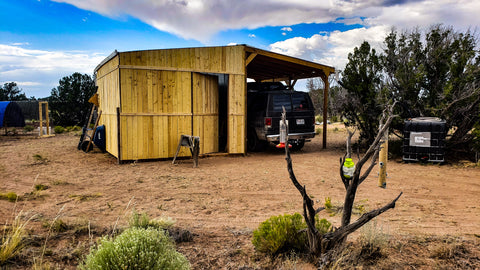
In addition to my camper van, the first structure I built was my shop. Because it was under 200 square feet, it didn’t require permits where I live. It cost me about $4,000 in materials. The main purpose was to store tools, supplies, and food, and in an emergency, I could stay in there too.

That shop also created a surface to harvest rainwater. I connected gutters to IBC totes for storage, which brings us to water.
Rainwater harvesting and storage
Water is life. I wanted a system for water right out the gate. For me, that meant having a trailer and a tank so I could haul water until my rain harvesting system was big enough.
I started with a corrugated roof and gutters going into IBC totes. Simple screens keep pests out. Chlorine can control bacteria. Filtration removes impurities and removes most of the chlorine too.

As the homestead grew, I expanded. I dug DIY underground cisterns around 3,600 gallons each, and I dug two ponds that hold about the same.

The roof system diverts water to the cisterns. Swales divert water to the ponds. Using the land itself to direct water increased my harvesting dramatically. Currently, I’m capable of harvesting and storing around 20,000 gallons annually.

To automate watering, I built a water tower about 20 feet above ground. About once a week I pump 330 gallons up, and from there everything gets water with solid pressure, even if my solar system goes down for a bit.

Even my outhouse has a mini-system: rainwater harvesting for a handwashing station. That 5-gallon container has never dried up since the first time it filled.
Grow your own food

When I first moved off-grid, I brought about a one-year supply of canned food, flour, sugar, and other staples. Since then, I learned to garden.
I keep several types of lettuce and a few vegetables growing year-round, with my largest harvest of the year usually being around fall.

I learned to raise pigs and keep hundreds of pounds of pork on the homestead. I no longer need to buy meat.

My chickens provide about six eggs a day for most of the year. I haven’t sat down at a restaurant since I’ve lived here, and I’ve only grabbed fast food twice in nearly four years.

About 25% of my dog’s food is grown on the homestead, and I’ve harvested thousands of pounds of native grass for livestock. I’ll continue focusing on growing feed and rotating animals more efficiently over time.

I keep a root cellar stocked with long-term food storage, and in fall when I fill it with squash, it easily keeps until spring.
Building your home, practical notes
Moving off-grid with a camper van meant I had shelter before I arrived. You could do the same with an RV or trailer. The first structure I built on the homestead was my shop, and depending on where you live, you could build a home with a similar approach. Remember as you move through this guide, this is only your first pass. These systems are meant to be improved over time.

Before building, I considered the topography. I built where water would not accumulate, and when it finally rained, I watched where water naturally moved so I could grade and direct it away from structures.
If you’re anywhere near a floodplain, elevate your buildings above possible flood level. Even if you’re not, at least build on skids or a base that keeps the structure out of moisture.
Simple framing basics matter: straight, square, solid anchoring, and building for wind if you live in wind. You don’t need to overcomplicate it. You need to build it right.
Animal shelter and fencing
It was just my dog Incus and me when I first arrived on raw land. We both stayed in the camper van. The first animal shelter I built was for chickens.
Using scrap materials, I framed a floor and created an arch with rewire, then built a small two-story coop in the back. I wrapped it with wire, protected the weak points, and kept it simple. It’s been working for years.

For fencing, my first setup was cheap and basic, and it still did its job: keep dogs in, keep predators out, and clearly mark private property. I upgraded the perimeter fencing later as my livestock needs changed.
Electric poly wire is cheap and effective if the charger and grounding are done right. When you need real strength, like horses, you build stronger corner posts, bracing, and proper tensioned wire.
Homestead safety and awareness
A remote homestead needs a safety plan. That doesn’t mean living in fear. It means being aware, being prepared, and layering simple systems that keep you informed.
For me, that looks like early awareness, clear boundaries, gates, fencing, animals, and infrastructure that reduces surprises. Some people call that paranoid. I call it prepared.
Cheap and easy water storage

I needed more than a few IBC totes for storage. You can buy large tanks, but I didn’t have that kind of money, so I built DIY cisterns with liners. It’s not fancy. It’s effective.
These systems can be improved in passes over time. That is a big part of the whole Frugal Off Grid approach. You do the best practical version you can, then improve as your resources and understanding grow.
The ponds are simply lined holes with swales feeding them. The cisterns are lined pits that stay stable and don’t freeze, which makes year-round water possible.

The water tower is the easy mode multiplier. With pressure, you can route water anywhere without constantly running pumps. I also use a float switch to automate refilling so it stays topped off.

Swales are just gutters for land. Anywhere water wants to accumulate, you can redirect it to where it helps you: ponds, gardens, trees, or storage.
Off-grid water filtration

Rainwater is clean, but storage is where things can go wrong. Keep containers opaque to prevent algae growth. Screen your gutters and inlets to keep pests out.
If you need to control bacteria in stored water, you can safely add a small amount of bleach to large volumes, and your filter will remove the majority of it. Follow common-sense labeling and keep your system consistent.
For a simple gravity system, two food-grade 5-gallon buckets with a bulkhead, a proper filter, and layered media can work. Run initial water through to rinse media, then keep it maintained. Simple wins.
How to make soil and fertilizer
I’ve never bought amendments, compost, or soil for my garden out here. I enjoyed the long, slow process of making my own. It took years, and it was worth it.
The trick in harsh environments is organic matter. It helps soil retain moisture and gives plants what they need. If you want a head start, hauling in manure to compost can save a lot of time.
Some manures need composting time. Others can be used sooner. You can also make manure tea fertilizer by soaking manure in water and using it diluted. The goal is simple: build soil that holds water and feeds plants.
High desert gardening

My biggest early issue was mice nibbling down starts. Year one, it hurt. You can out-plant them, you can trap, and you can use animals as part of the solution.

In year one, with no experience, I planted a full garden in native soil inside a 10x30 fenced area. I eventually wrapped it in 1/4 inch wire mesh, which helped a lot. I harvested produce that first fall, and improved every year after.
The point is: you can do it, and you’ll get better results as your soil improves.
Greenhouses, geothermal, and aquaponics

Wind, sun, and cold are the main enemies out here. A greenhouse helps with all three. If you want one structure that changes everything, it’s hard to beat a greenhouse.
Tent greenhouses can work when you’re broke, but long-term, a sturdy structure is worth it. Shade cloth, plant fabric, and layering for temperature control make a big difference.

One of my first major projects was a geothermal, walapini-style greenhouse. Between the earth temperature and airflow, it stays about 20 degrees warmer or cooler year-round.

My aquaponics system acts like a thermal battery in the greenhouse. It’s efficient, it recirculates, and it grows food while helping regulate temperature. It does require consistent power, but it’s one of the most productive systems I’ve built.
Homestead livestock

Livestock can give you manure, food, pest control, security, and more, but every animal adds complexity. More pens. More waterers. More feed. More time.
I currently keep chickens for eggs, pigs for meat, and I’m training two feral horses. Horses are demanding, but I believe they’ll pay dividends over time.
How to raise chickens
Chicks need heat for weeks, which takes real electricity. I avoid raising babies until summer is near. Protect your coop with 1/4 inch wire mesh where predators and snakes are an issue, give them perches, and keep things clean and consistent.
How to raise pigs
Pigs are easygoing overall, but piglets need warmth early on. Keep shelter dry, protect piglets from being crushed, and keep your system simple. They can turn feed into meat efficiently, which is why I focused on them.
How to train feral horses
Patience is the way with horses. You earn trust in small steps, day after day. Start by simply being around them, then slowly build comfort with touch, handling, and basic cues. If they spook, go back to the last comfortable step and build again.
Root cellar
Being able to safely store food you grow is a huge part of self-sufficiency. My root cellar is simple: a sealed space in the earth with shelving, ventilation, and a door that holds temperature.
It isn’t perfect by textbook standards, but it works, and it extends my food storage year-round.
How to build a solar system

I’m not an electrician. That said, solar doesn’t have to be complicated. You can buy all-in-one units, or you can piece together a system if you’re willing to read and learn.
A practical starting point for many people is a 48v hybrid charger and inverter. You’ll want battery storage and enough panels to keep up with your daily use, and you want the system to be expandable.
Grounding matters. Do it right. Protect your system. Once you’re stable on power, you can add comfort upgrades like efficient cooling, better pumping, and automation.
How to make homestead income
There are many ways to make income from your homestead. Remote work is more common now. Local trade skills like carpentry, welding, and equipment work can be strong too. Small businesses can work if you stay consistent and keep your costs sane.
The most important thing isn’t just how you make money. It’s how you spend it. Lower costs make everything easier. Fewer bills means more freedom.

Whether you earn money online, locally, or both, the goal is the same: build stability, build options, and build a life that doesn’t require constant panic.
Optional next steps
This free guide stands on its own. It is a practical starting point based on how I actually began building my off-grid homestead in the early years.
After living this way longer, I eventually organized Frugal Off-Grid into a four-step system:
- Start with the county.
- Find land that may fit your goals.
- Check the land before you buy.
- Build the homestead in the right order.
This free guide is the free version of step four. It introduces shelter, water, food, power, and income from my own lived experience.
If you want more depth, the ebook gives you a more organized systems-based version of step four. If you want the full structure in one place, The Frugal Off-Grid Path is the most complete version, with the roadmap, lectures, tools, and deeper walkthroughs together.
Not Ready To Move Forward With The Path Yet?
Start with this free workshop. It walks through the systems, order of operations, county research, and practical mindset behind building a frugal off-grid homestead without unnecessary chaos or expensive mistakes.
13 comments
Angels, wow, you’ve been mapping it all out. Congratulations on your move and don’t forget that you can go back in passes and improve imperfection.
I’ve been watching your YouTube for 5 1/2 years learned lots from you. I’m buying 20 acres rawland but before I move on mm land land I’m getting all solar panels n everything before I move there be better prepared.
A pdf version would be great! Nice marketing strategy. I myself find myself living in a box truck, wanting to do a similar thing for people who need basic, heating, water, and shelter strategies that are very low cost and award for long-term comfort, reliability, independence
I’ve been watching your videos and have found them to be entertaining and informative. It is very impressive how you have turned scrub desert into an oasis. Thank you for the video content.
Invaluable knowledge. Thank you!